
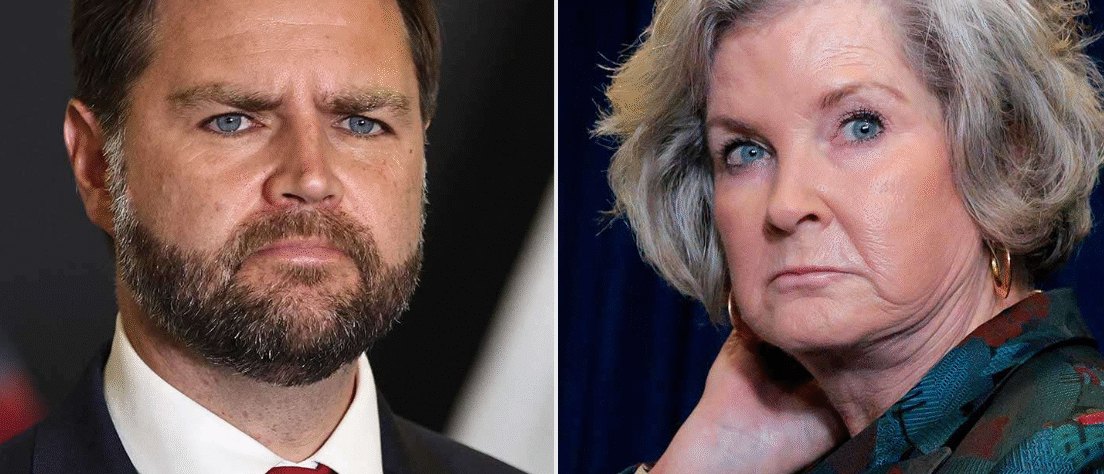
White House Chief of Staff Susie Wiles has publicly disputed significant portions of a recent Vanity Fair article that portrayed internal tensions and controversial personalities within President Donald Trump’s second-term administration. Wiles accused the magazine of selectively presenting her remarks to construct what she described as a “chaotic and negative narrative” about the White House and its senior officials.
Wiles, 68, who made history earlier this year as the first woman to serve as White House Chief of Staff, addressed the controversy shortly after the article’s publication. In a post on social media platform X, she said that Vanity Fair had ignored crucial context from her extensive interviews with the magazine, which spanned nearly a dozen conversations.
“Significant context was disregarded,” Wiles wrote, adding that comments from herself and others were omitted in order to frame the administration in an unfairly hostile light.
Controversial Descriptions of Trump, Vance and Musk
The Vanity Fair profile attracted widespread attention due to several striking characterisations attributed to Wiles, particularly about President Trump, Vice President JD Vance, and billionaire entrepreneur Elon Musk.
In the article, Wiles was quoted as describing Trump as having an “alcoholic’s personality,” despite the president being a teetotaler. She explained that her perspective stemmed from growing up with an alcoholic father, which she said gave her insight into managing “big personalities” with intense, driven traits.
“High-functioning alcoholics or alcoholics in general have exaggerated personalities,” Wiles was quoted as saying. “So I’m a little bit of an expert in big personalities.”
She suggested that Trump governs with a mindset of limitless capability, saying he approaches leadership believing “there’s nothing he can’t do.”
Trump later responded to the controversy in an interview with the New York Post, where he strongly defended Wiles, calling her “fantastic” and suggesting that she had been “deceived” by the Vanity Fair writer. The president added that her remarks about his personality echoed observations he himself had made in the past.
JD Vance Responds Calmly
Wiles’ comments about Vice President JD Vance also generated headlines. She reportedly described Vance as having been a “conspiracy theorist” for much of the past decade and suggested that his political evolution—from a vocal Trump critic to a close ally was at least partly strategic.
When asked about the report by journalists on Tuesday, Vance said he had not read the article. He added that he only believes in conspiracy theories that later prove to be true, citing concerns raised during the previous administration about former President Joe Biden’s health.
Sharp Words for Elon Musk and DOGE Reforms
Perhaps Wiles’ most candid remarks were reserved for Elon Musk, who earlier this year headed aggressive cost-cutting efforts under the Department of Government Efficiency (DOGE). Musk left the administration in May following a highly public and acrimonious split with Trump, during which the two traded insults online.
In the Vanity Fair article, Wiles described Musk as an “avowed ketamine user” and characterised him as eccentric, saying he slept in a sleeping bag inside the Executive Office Building.
“He’s an odd, odd duck as I think geniuses are,” she said, adding that while his approach was not always helpful, Musk operated entirely on his own terms.
Wiles also revealed that she strongly opposed Musk’s push to dismantle parts of the U.S. Agency for International Development (USAID), recalling that she was “initially aghast” by the proposal.
“Anybody who has ever paid attention to USAID knows they do very good work,” she said.
At the same time, Wiles acknowledged Musk’s philosophy of rapid, disruptive reform.
“Elon’s attitude is you have to get it done fast. If you’re an incrementalist, you’ll never get your rocket to the moon,” she said. “With that attitude, you’re going to break some china.”
Retribution, Power and Internal Dynamics
Wiles also addressed allegations that Trump’s administration seeks retribution against political adversaries. While she denied that the president fixates on revenge, she conceded that retaliation can play a role when opportunities arise.
“I don’t think he wakes up thinking about retribution,” she said. “But when there’s an opportunity, he will go for it.”
Widely regarded as one of the most powerful figures in Trump’s second-term White House, Wiles has worked closely with the president for years, including serving as his Florida campaign manager in 2016 and later overseeing fundraising operations through the Save America PAC.
White House Closes Ranks
Following the article’s release, the White House moved swiftly to defend Wiles. Press Secretary Karoline Leavitt told the BBC that Wiles has been instrumental in what she called “the most successful first 11 months in office of any President in American history.”
“President Trump has no greater or more loyal advisor than Susie,” Leavitt said. “The entire administration is grateful for her steady leadership and stands fully behind her.”
Later, speaking to reporters outside the West Wing, Leavitt accused Vanity Fair of “bias of omission,” arguing that the magazine failed to include comments from other White House staff and presented Wiles’ remarks “wildly out of context.”